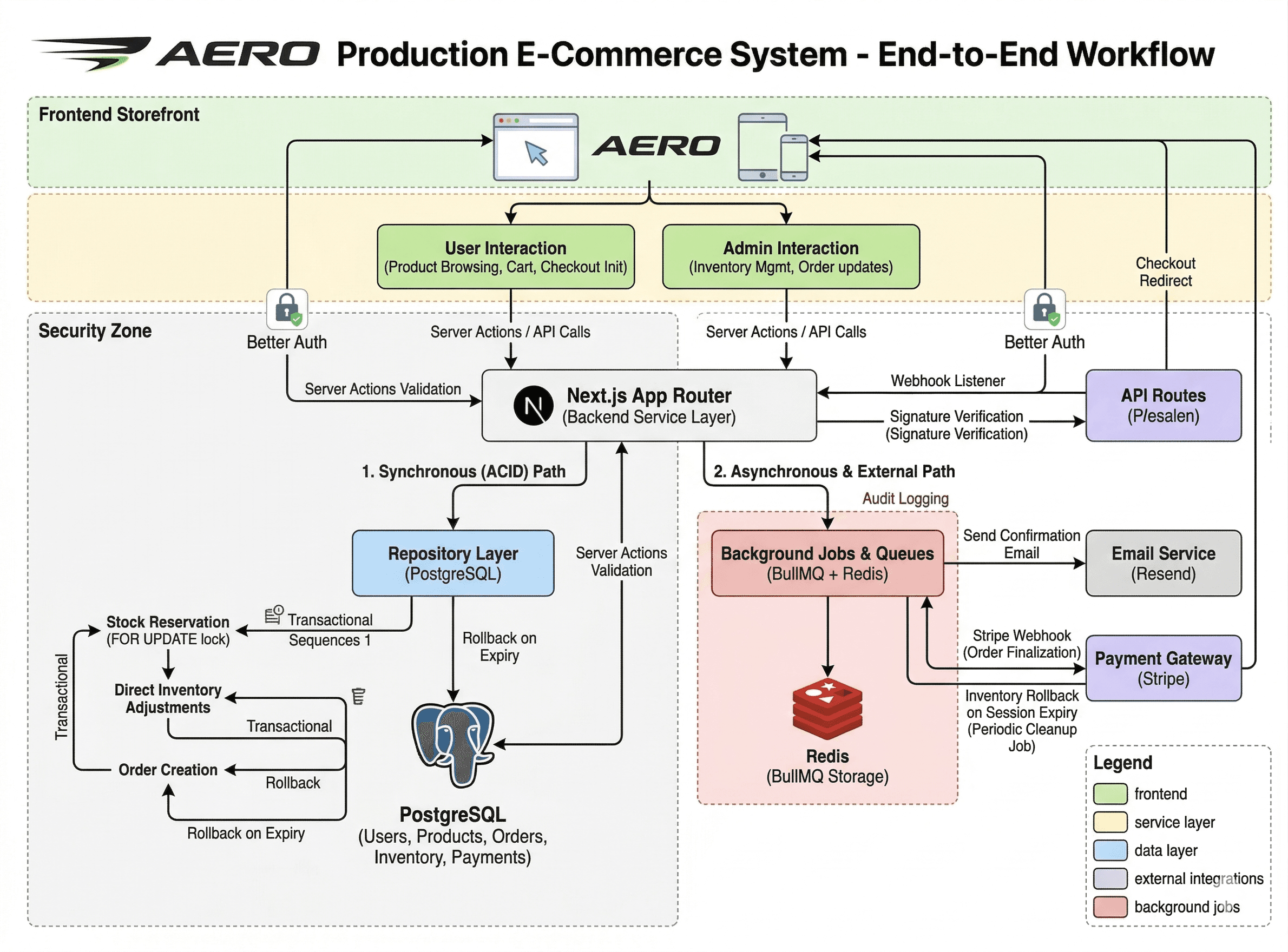
Building a Modern E-Commerce System: The Architecture Behind Aero
Most e-commerce projects look simple on the surface — products, cart, checkout. But once you move beyond demos, the real challenge is designing a system that is fast, scalable, and reliable under real usage. Aero was built with that mindset: not just as a storefront, but as a production-ready full-stack system.
Performance is the foundation of any e-commerce experience. Slow pages directly translate to lost conversions. Using Next.js, Aero leverages server-side rendering for fast initial loads, optimized routing and code-splitting, and efficient data fetching strategies. The goal is simple: reduce time-to-interaction as much as possible, especially on product and landing pages.
Data consistency becomes critical as soon as users start interacting with the system. With Prisma and PostgreSQL, the backend is designed to be fully type-safe across the stack, predictable in schema evolution, and easy to maintain as complexity grows. Instead of writing raw queries, Prisma acts as a structured layer that ensures data integrity and developer confidence.
One of the less obvious challenges is database connection management. In serverless environments, multiple instances can spin up simultaneously, quickly exhausting database limits. To handle this, Aero integrates a connection pooling strategy, ensuring stable performance under load. This is the kind of issue that doesn't show up in tutorials — but breaks systems in production.
E-commerce isn't just about data — it's about state: cart updates, product selections, user sessions. Aero is designed to keep state transitions smooth and predictable, ensuring that interactions feel instant and reliable. Small UX decisions — like optimistic updates or persistent cart behavior — make a significant difference in perceived performance.
As features grow (auth, payments, dashboards), structure becomes more important than speed of development. Aero follows a modular approach: clear separation between UI, logic, and data layers, reusable components for consistency, and a scalable folder structure aligned with features. This allows the system to evolve without becoming fragile.
The biggest shift while building Aero wasn't adding features — it was thinking in terms of systems and trade-offs. Every decision involved balancing performance vs flexibility, simplicity vs scalability, and speed of development vs long-term maintainability. That's what turns a project into something closer to a real-world product.